Knowing your breasts — their landscape, rhythm, and language — is one of the most loving acts of prevention. This is not about searching for what's wrong. It's about becoming fluent in what's normal for you.
The breast is a soft, layered organ — glandular tissue, fat, ligaments, lymph, and nerves wrapped in skin. It changes through your cycle, your seasons, and your years. The goal of this chapter is not vigilance, but familiarity.
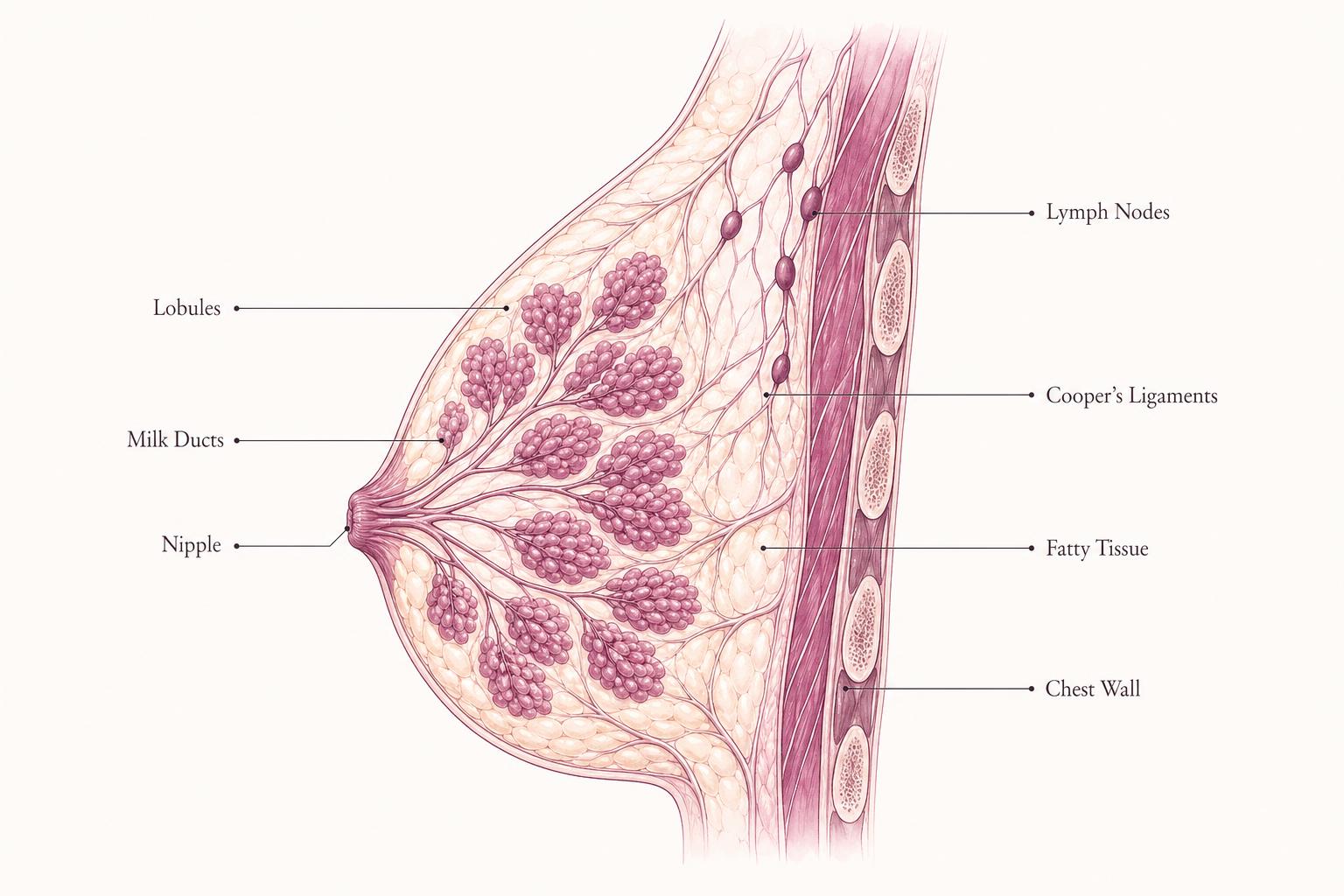
A side cross-section of the breast — the layers that hold milk, lymph, and feeling.
Structure
What lives inside the breast
Lobules
The milk-producing glands. Estrogen-sensitive — most cancers begin here or in the ducts.
Ducts
Tiny channels that carry milk from lobules to the nipple. The site of most ductal carcinomas.
Adipose (fatty) tissue
Fills the spaces between glandular tissue. Produces estrogen — especially after menopause.
Connective tissue & ligaments
Cooper's ligaments give the breast its shape and lift.
Lymphatic vessels & nodes
A dense network draining toward the underarm, collarbone, and chest wall — the body's quiet cleansing system.
Blood vessels & nerves
Carry oxygen, hormones, and sensation. Disruption here can show up on a thermogram before structural changes appear.
A quiet truth
The breast is not separate from you. It responds to your meals, your sleep, your grief, your laughter, and the air in your home.
Mapping
The six zones to know
Each breast can be divided into regions. When you check, move slowly through all six.
Front-view diagram dividing the breast into six zones to know when performing a self-exam.
01Upper Outer — Most cancers found here
02Upper Inner — Often overlooked
03Lower Outer — Drains toward underarm
04Lower Inner — Hard to image
05Areola & Nipple — Watch for discharge or scaling
06Tail of Spence — Extends into armpit
Daily devotion
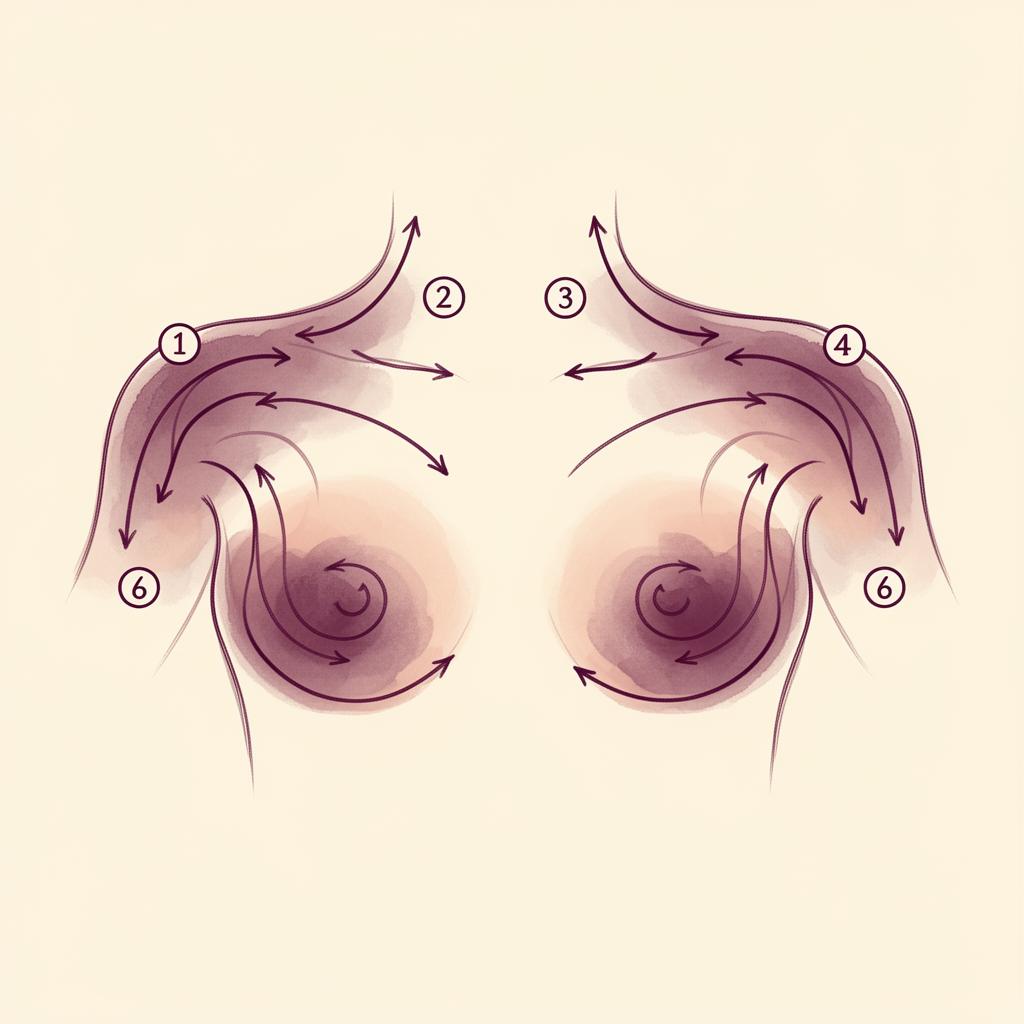
Lymphatic self-massage
Three to five minutes, three times a week. Best before your morning shower or in the evening before bed.
Always move toward the lymph nodes — outward to the underarm, upward to the collarbone.
01Sit or lie comfortably. Warm a small amount of organic oil (jojoba, almond, or castor) between your palms.
02Begin under the collarbone. Use light, circular strokes moving outward toward the shoulder.
03With flat fingers, glide from the breastbone outward toward the underarm — always moving toward the lymph nodes.
04Cup the breast gently and lift upward, then sweep outward toward the armpit.
05Make small circles around the entire breast in a clockwise spiral, ending at the nipple.
06Finish with five slow strokes from the breast toward the underarm, then five toward the collarbone.
Monthly practice
The breast self-exam
Ten quiet minutes, once a month. Approach it with curiosity — not fear.
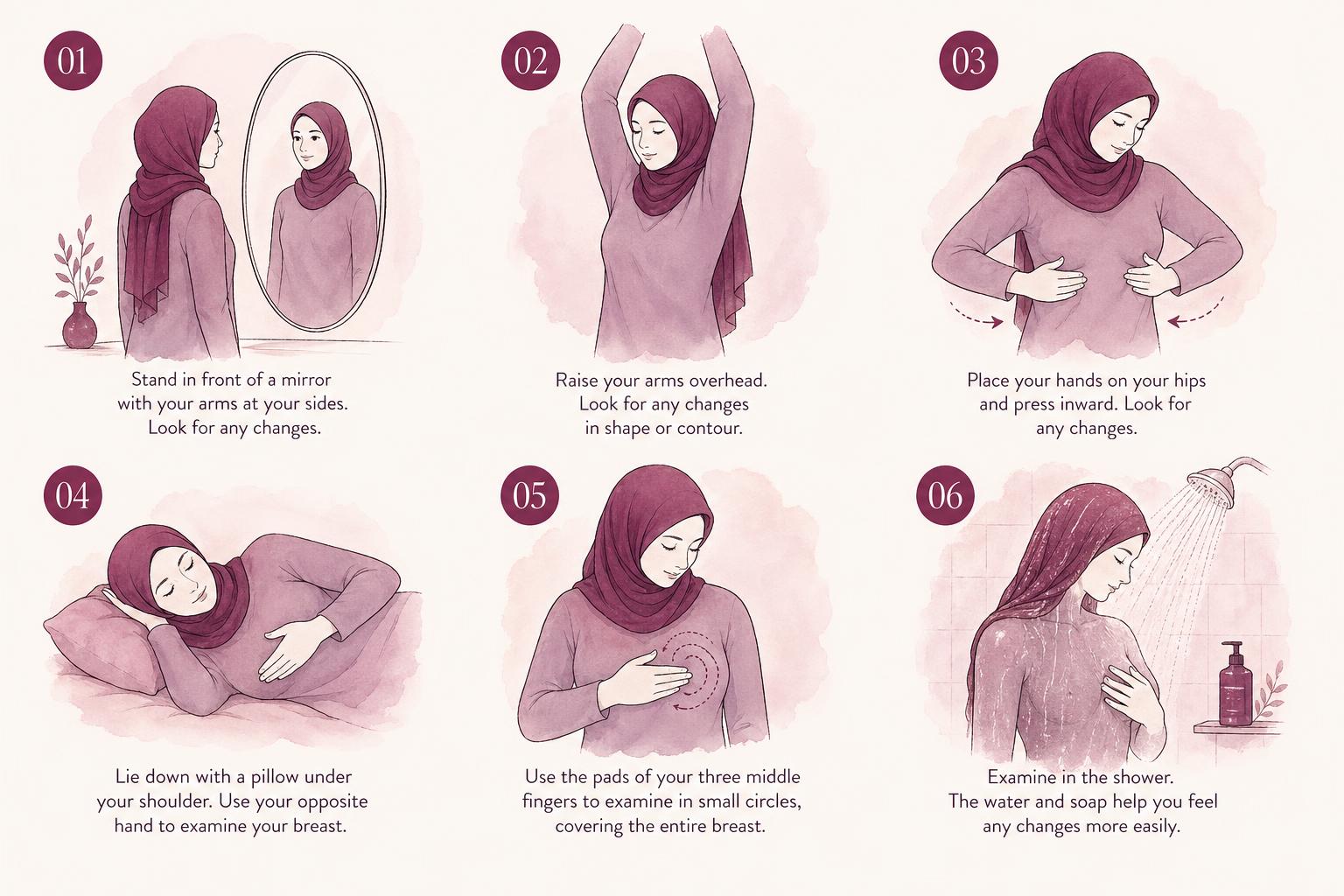
Six positions, three pressures, one quiet practice — once a month.
01Choose a consistent day each month — ideally 7–10 days after the start of your period, or the first of the month if you're post-menopausal.
02Stand before a mirror with arms at your sides. Notice symmetry, skin texture, dimpling, and nipple position.
03Raise your arms overhead. Look again. Then place hands on hips and press inward to flex the chest wall.
04Lying down, place a small pillow under your right shoulder. Use the flat pads of your left three middle fingers.
05Move in small overlapping circles, using three levels of pressure: light, medium, firm. Cover the entire area from collarbone to bra line, sternum to armpit.
06Repeat on the other side. Then, sitting or standing, repeat in the shower with soapy hands — tissue moves differently when wet.
When to call your practitioner
Findings worth a conversation
Most lumps are benign — cysts, fibroadenomas, or hormonal changes. But these warrant a call.
•A new lump or thickening that feels different from surrounding tissue
•Persistent skin dimpling, puckering, or an orange-peel texture
•Nipple inversion that is new, or spontaneous discharge (especially bloody or clear)
•Persistent redness, warmth, or scaling on the breast or nipple
•Swelling in part of the breast or in the underarm
•A feeling that something has changed — even without a clear lump
Reflection
›How does my body feel about being touched with care?
›What story have I been told about my breasts — and is it still mine?
›Which day of the month will I claim as my self-exam day?
This week's practice
Three small acts
01
Schedule your self-exam day on your calendar — repeating monthly.
02
Buy a small bottle of organic oil dedicated to breast massage.
03
Spend three minutes this week placing both hands on your chest, breathing slowly.