The conventional path
Surgical, oncological, and radiological care, when needed, can be life-saving. Choose practitioners who listen, explain, and respect your timeline.
Chapter 18 · Section V — Healing & Working with Practitioners
A finding is information, not a verdict. The first work is to slow down enough to hear it clearly.
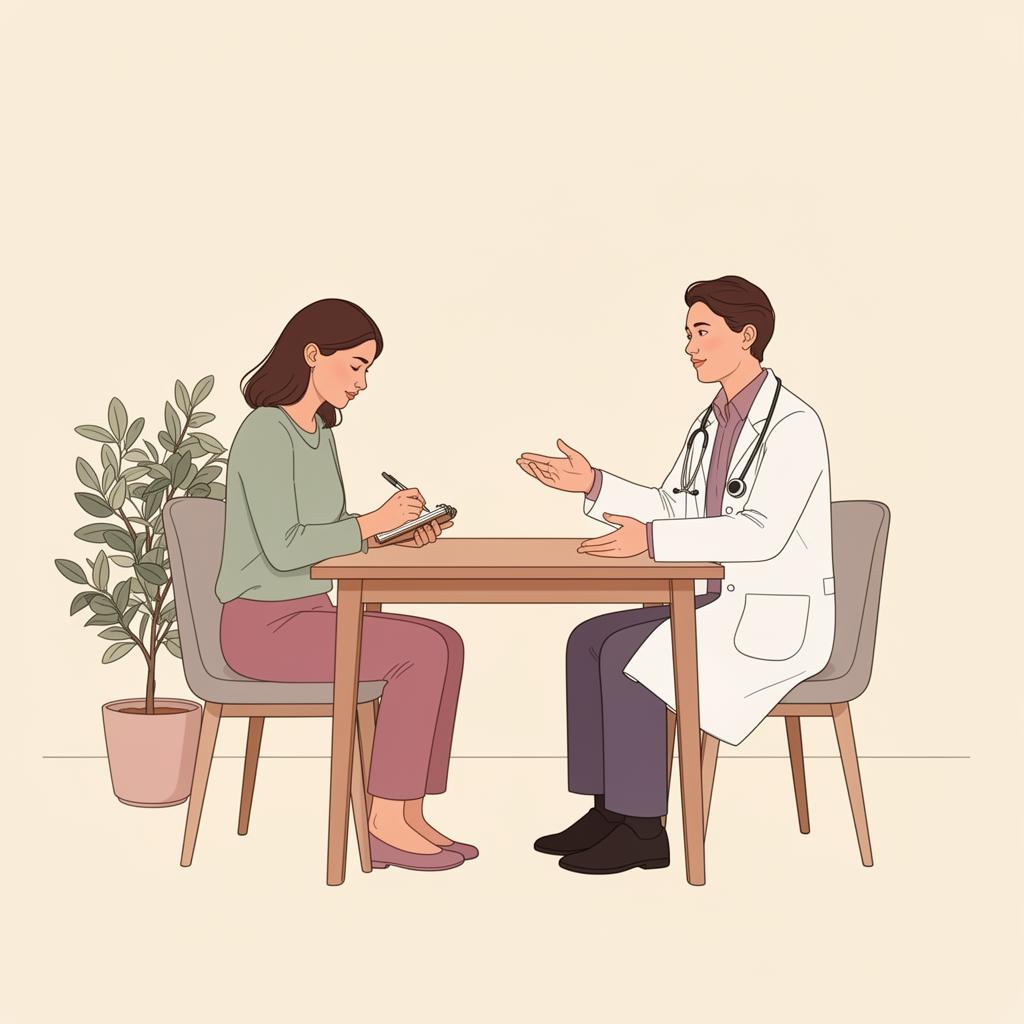
Almost every woman who pays attention to her breasts will, at some point, hear a phrase that starts the heart pounding: "There's something we'd like to look at more closely." A scan flags an area. The doctor's hand pauses. A self-exam turns up something new.
This chapter is not about diagnosis or treatment — both belong with qualified practitioners who know your body. It is about the in-between time. The hours and days between a finding and a clear next step. That in-between is where many women lose their footing — not because the news is bad, but because no one taught them how to stand inside the unknown.
Four Steadying Principles
About 80% of breast biopsies return benign results. Fear is a natural first response — and not yet a verdict on what is true.
Almost no decision needs to be made the same day. The body that has carried something for months can wait two weeks for a clear plan.
Ask for copies of every scan, report, and pathology slide. Read them. Bring them to second opinions. Ownership of your data is ownership of your care.
Asking for another perspective is not disloyalty. It is the standard of care any thoughtful practitioner welcomes.
The first three days set the tone for everything that follows. A nervous system in panic makes worse decisions than one that has breathed. Move through these six steps in order — slowly.
The internet at 11 p.m. is no friend to a worried woman. Take three slow breaths. Then write down exactly what was said, in the words used.
Request your full radiology or pathology report — not just the summary. Note the BI-RADS category, lesion size, location, and any descriptors used.
Share the news with one calm, grounded person before telling anyone else. Their steadiness becomes a vessel for your own.
If a follow-up scan, ultrasound, or biopsy is recommended, book it within a week or two. Waiting is harder than knowing.
Notify your integrative practitioner, naturopath, or thermographer so they can support you alongside conventional follow-up.
Eat well. Sleep. Move gently. Detox practices continue. The body still needs its rhythms — perhaps now more than ever.
Most mammography, ultrasound, and MRI reports include a BI-RADS category — a standardized 0–6 scale that summarizes the radiologist's assessment. Knowing what each number means turns a frightening report into a clearer conversation.
| BI-RADS | Meaning | What it usually means for next steps |
|---|---|---|
| 0 | Incomplete | More imaging is needed before a category can be assigned. Not a finding — just a pause. |
| 1 | Negative | Nothing to report. Routine screening continues. |
| 2 | Benign | A definite benign finding — a cyst, calcification, or stable feature. No follow-up beyond routine. |
| 3 | Probably benign | Less than 2% chance of cancer. Usually short-interval follow-up in 6 months to confirm stability. |
| 4 | Suspicious | Biopsy is recommended. Sub-categories 4A (low), 4B (moderate), 4C (high) refine the suspicion level. |
| 5 | Highly suspicious | ≥95% likelihood of malignancy. Biopsy is recommended for tissue diagnosis. |
| 6 | Known malignancy | Used for biopsy-proven cancer being monitored before or during treatment. |
Walk into every appointment with these questions written down. The worst time to remember what you wanted to ask is on the drive home.
What exactly was found, in plain language? Can I see the image?
What is the BI-RADS category, and what does that mean for my situation?
What are all my next-step options — and what happens if I wait two weeks?
If a biopsy is recommended, what type, and why that one?
Will the biopsy be reviewed by a breast-specialty pathologist?
Can I get a copy of every scan and report to keep in my own records?
Who would you recommend for a second opinion?
Is there an integrative or naturopathic oncologist you trust?
Healing rarely happens on a single track. The most resilient outcomes come from women who weave conventional, integrative, and terrain-based care into one coordinated team — with themselves at the center.

Surgical, oncological, and radiological care, when needed, can be life-saving. Choose practitioners who listen, explain, and respect your timeline.
Naturopathic and integrative oncologists work alongside conventional teams to support immune, metabolic, and emotional resilience throughout treatment.
Whether or not active treatment is needed, the daily practices in this workbook continue: nutrition, lymph, detox, sleep, connection, breath.
Avoid making major life decisions (selling a house, leaving a job, ending a relationship) in the first two weeks after a finding.
Be wary of any practitioner — conventional or alternative — who pressures you to decide today, or who dismisses other options.
Avoid extreme protocols (water fasts, aggressive detox, IV therapies) without a qualified practitioner overseeing them.
Do not face this alone. Even one trusted companion changes the chemistry of the experience.
A reflection
"You do not have to know the whole road. You only have to take the next true step."